City of Kings is a fantasy novel set in Rob Hayes’ ‘First Earth’ sequence. It shares the setting with several duologies, and may be read as a sequel to one of those. However, City of Kings sets out to be a standalone novel, and it mostly succeeds. I found having the extra context from some of the other books in the sequence was useful, and added a bit of narrative flavour, but the story rumbles along perfectly well without any further knowledge.
This is a book about sieges, personal and, well, slightly more physical. The latter is clear enough. Crucible is a city of kings. Well, nobles. They’re a shifty lot, with not much to recommend them, other than a sense of implied privilege, and rather a lot of armaments. Crucible is under siege from an army led by our protagonists. It sits in the Wilds, an area apparently mostly lawless and akward, where the nobility has been thoroughly impressed with the notion of private law. They are, in sum, not used to getting their own way, and the countryside has risen up against them, arranged to brutally murder their friends, and now sits outside their door. The city of the title is a fortress. Murder holes. Walls for miles. Traps. Arrows everywhere. It’s not the sort fo place you want to storm. Hayes’ description is sparse but precise; it shapes the idea of a walled, impregnable city in the mind of the reader, and leaves you to fill in the rest.
The author does shape a believable world; the towering walls of Crucible feel as blank and imposing as they might ti any infantry on the wrong side, and the larger social system, where the ‘Blooded; sit over the top of the citizenry and soldiers is, of course, fairly familiar. Indeed, the revolt the reader is asked to step into, led by the Black Thorn (see below) has echoes of the peasant’s revolt about it. As the city falls under siege, it also aches with burn scars, with catapults, with assassination squads sent under the cover of darkness, with explosions, with the sense of necessity. This is a word which is nasty, brutish and short, but also has the hum and crackle of a space which is absolutely alive.
The Black Thorn is our clearest entry point into this space; he’s a thief, a murderer, an unashamed killer. He’s also a man in love, and a man who has made, and recognises, mistakes. Stolid, thoughtful, and increasingly aware of his own mortality, the Black Thorn is someone continually attempting to divest themselves of their own reputation. Still, he has a dry, cynical, world-weary delivery which matches the continual barrage of the story, and makes you wake up and care. The Thorn also has his own connections – relationships and old friendships, rendering his actions fraught with interpersonal complexity and peril. You may be asking, is the Thorn convincing, compelling enough to keep you turning pages. Yes, I think so. He’s an archetype to be sure, a villain turned hero, exhausted by his own existence – but convincing enough, and the humanity is there in every page, the emotional depth and resonance keeping you looking forward.
There’s a diverse cast of course, from the ruthless outlaw queen-in-waiting, whose motives may not be as dark as they seem, to the struggling, fighting, dying squaddies desperate to get into the city, or at least not to be shot full of arrows. The villains of the piece are certainly the Blooded, the enemy, sat on their walls, throwing insults from an insulated position where privilege protects from consequence. They’re an awkward lot, and repulsively entertaining to read; that dealing with them requires moral compromise seems obvious, but also causing issues for those on the ground.
And what ground it is. This is the war story you’re looking for. Ladders on walls. Boiling oil. Sappers. Trolls. There’s blood absolutely everywhere. In a sense this is more a character piece, about how people deal with stress, anxiety, the potential and reality of disaster. It’s also a war story, and a comedy, and, as the drama rachets up, a heist in the making. There’s a lot going on between the flights of arrows and the swing of swords – and you should definitely be paying attention.
I’d recommend this book as a stand-alone; having the context of other books in the same world adds something, but even without those, it’s a page-turning adventure.
Wednesday, November 7, 2018
Wednesday, October 31, 2018
The Way of the Shield - Marshall Ryan Maresca
The Way of the Shield is the start of a new fantasy series
from Marshall Ryan Maresca. It shares a setting with his other series – the sprawling
metropolis of Maradaine, populated by mages, vigilantes, police investigators,
criminals, cults, politicians – and now, knights.
The centre of the narrative is Dayne. Dayne is a member of
the Tarian order, a group of heavily armed individuals with a code. There used
to be more of these orders, but they’ve been slowly subsumed into the army and
other government initiatives over the years, and now only the Tarians and one
of the others are left. Dayne is an exemplar of Tarian values – keen to help
those who can’t help themselves, and to protect lives. He has a degree of guilt
for his inability to stop the deaths of those tht he’s protected in the past –
but the Tarians demand he gets up in the morning, picks up his shield, and goes
on to see what’s text.
Dayne is almost worryingly wholesome. He’s perpetually
self-deprecating and self-punishing, at the same time as he lvies up to all the
higher ideals of his order. A nice guy, but stern – a paladin in the making.
Fortunately, perhaps, he’s backed up by a posse of other characters with their
own flaws, I particularly enjoyed his friendship with a group of
newspaper-folk, which provided the opportunity for exposition, some charmingly
sharp witty banter, and a chance to explore the subtext of the role of the
press in a less-than-free society.
Because that’s what Maradaine is, to be sure. It’s a
metropolis, a city whose economy is thriving, whose people are surging through
the streets. But it’s a city whose body politic is moribund. There’s a king who
seems absent, and a parliament populated by the rich, the venal, the power
hungry, or some combination of all three. Parliament represents the people, as
long as the people are people like themselves – and that leaves those outside
their circle fuming and aware of the injustice. If you can vote, but your vote will
bring in one of two identical candidates – then where’s the choice? The Maradaine
electorate is on the boil; the air of the city thick with tension.
Into thishotpot of havoc slides a conspiracy – I won’t get
into details here, but they plan to change Maradaine’s politics, they would
claim for the better. If the detailed, in-depth world-building is one of this
book’s strengths, another is its antagonists; their goals are, if not laudable,
at least understandable in a world of realpolitik.
If their means are unpleasant, involving riots, deaths, assassinations,
they’re backed by the pragmatic service of an achievable goal. These are not
villains in their own minds, and we get some exposure to their point of view.
In another book, they might even serve as the heroes; here
though, they are reflected in Dayne’s moral certitude, and found wanting. That
said, Dayne’s not on his own; he’s backed by a Tarian trainee, and her attitude
can mostly be described a stubborn and fierce. In between debates with the
press-gang, seeing her work with Dayne is a joy. The fights are gloriously choreographed
and kinetically hefty; you’ll taste the iron in the back of your throat, and
slip on the blood on the floor from the drawn blades.
This is an adventure story. Dayne throws himself into
righting wrongs, almost by accident. If he carries his own guilt, that just
makes him more genuine. Despite his competence, his relative youth seems to leave
him emotionally vulnerable in a city filled with movers and shakers with less
moral rectitude and more emotional armour. But Dayne does right wrongs, and
does so with a force of personality which you can feel pervading every word on
the page. This is a story of heroes. Dayne, for sure, the moral beacon. But his
friends bear him up, and keep hom facing in the right direction. His trainee –
well, she’s amazing. Stubborn, forceful, confident in her own capability,
refusing to take any crap from anyone. If Dayne is the centre, the spine of the
story, she and his other friends are the muscles.
It's a poitical story, one which both demands and rewards
your attention. It’s a personal story, dealing with pain, loss, heartbreak and
forgiveness. It’s a story about morality, about sacrifice, about what people
want from life. It’s a fun story – there’s quips, swordfights, chases through
the streets. It’s a compelling, convincing work of fantasy, and a worthy
addition to the rich tapestry that is the works of Maradaine. Pick it up, give
it a try – you won’t be disappointed.
Wednesday, October 24, 2018
Skyward - Brandon Sanderson
Skyward is a book which is about several things at once. On
the one hand, it’s a story about humanity, hiding out in bunkers beneath the
surface of a battered world to avoid the attentions of a mysterious enemy. That
world is only recently united, and now ina perpetual state of war, it inches
along the unknowing precipice of totalitarianism, or militaristic deification. On
another, it’s the story of a young girl trying to live up to the stories she’s
told herself about her father, or live down the stories others tell about him.
On the third hand, it wants to explore friendships, dig into the relationships
that help carry us through the day – and whether we’re willing to bear their
costs.
Before we get too far though, I want to share my initial
review of Skyward, which I sketched out in the first twenty minutes after I
finished it, having spent a day reading:
Is this good? Yes. I read it in a day. I stayed
up far too late to see where it went, how it ended, and what might happen next.
I finished it 20 minutes ago, and I’m still buzzing with the energy of the story.
In short summary: Not a doorstop, narratively tight, hits some emotional beats that I felt in my gut. Some really solid worldbuilding and emotive, precise characterisation.
And also space fighter combat and explosions. Lots of that.
Heart-in-mouth, tensely paced battles, bookending questions about a young woman finding herself and examining a society that seems to be in a...not great place. Looks at some deep moral dilemmas and gives you some people to care about, to feel for and with. Triumphs, defeats, hope and pain.
Yeah, you’ll want to read this one. It crackles with potential, and delivers a story with a raw, genuine kick you can feel in your bones.
More later. But this? It’s different to say, Mistborn or Stormlight. But it has the same capacity to intrigue, devastate and enchant by turns. In its capacity to make you live, to feel, it’s Sanderson at his best.
I finished it 20 minutes ago, and I’m still buzzing with the energy of the story.
In short summary: Not a doorstop, narratively tight, hits some emotional beats that I felt in my gut. Some really solid worldbuilding and emotive, precise characterisation.
And also space fighter combat and explosions. Lots of that.
Heart-in-mouth, tensely paced battles, bookending questions about a young woman finding herself and examining a society that seems to be in a...not great place. Looks at some deep moral dilemmas and gives you some people to care about, to feel for and with. Triumphs, defeats, hope and pain.
Yeah, you’ll want to read this one. It crackles with potential, and delivers a story with a raw, genuine kick you can feel in your bones.
More later. But this? It’s different to say, Mistborn or Stormlight. But it has the same capacity to intrigue, devastate and enchant by turns. In its capacity to make you live, to feel, it’s Sanderson at his best.
If that’s enough for you – get out there and pick up a copy
now. If not, there’s some more details below….
It’s a mark of Sanderson’s talent that though this is a
sci-fi story, and though the soaring fighters and tired instructors feel as
exotic as they do familiar, it holds a personal tale close to heart. Yes, there’s
dogfights, and rivalries and heroism, and defeats and victories, and all of
those things will get your adrenaline going and have you turning page after
page after page, heart in mouth as you wonder if anyone will survive – but it’s
the quieter moments, of a girl finding herself, refusing to give up, refusing
to accept who she’s told she is, that seem to live at the heart of the text.
Spensa is our guide in this world, a young woman whose goal
in life is to fly. The flyers are the rock stars of her world – and everyone
else’s. Humanity lurks in caverns, out of sight of an enemy which persistently
attacks any surface gatherings. Only one surface facility exists, and that only
for decades. It’s here that humanity is making a stand – manufacturing fighters
which are allowing them to take the fight to an enemy which has been
ever-present for generations. The pilots are the public face of the war, a war
which demands victory and total devotion to the cause of survival. Becoming a
pilot is terrifyingly competitive – only the best of the best of recruits are allowed
to fly the limited stock of fighters. It can also be lethal, with live fire
exercises likely to involve enemy incursions, and with ejection informally
discouraged as cowardice or as a moral failing – the pilot surviving rather
than working until the last moment to save their fighter.
It’s a society teetering on the edge of something, to be
sure. Pilots are worshipped, and the military idolised by a civilian population
with no other way to hit back.
And that’s where Spensa comes in.
Smart, driven, and clearly unwilling to take any crap from
anyone, she suffers from social ostracism; she and her mother eking out a
living on the fringes of a society which has no place for her. With a palpable
frustration that her social situation might prevent her from flying, and
something of a grudge against the descendants of celebrated pilots, who get to
enter flight school without undergoing the gruelling tests Spensa herself
struggles to be allowed to undergo, she’s got a roiling emotional heat which
steams off the page. It’s counterbalanced somewhat by Spensa also being rather
likable. She has a deep sense of loyalty and friendship, and a highly developed
sense of justice. That combines with her anger and leaves a passionate, fiery
young woman, who wants to succeed, wants to do something – and won’t take no
for an answer.
There’s something of a younger Top Gun vibe, as the pilots
of Spensa’s training squadron bond and banter amongst themselves. All are aware
that only a few of them will make the cut, though most are naïve enough not to
be entirely sure what that means. The story portrays that dichotomy well; these
are people desperate to fill a role, the best of the best – but also as
personally conflicted as anyone else. There are petty rivalries, friendships,
and internal squabbles. Above that is th the sheer certainty that what they do
is necessary, and their energy and pride in doing what they feel is the right
thing is obvious, and their hope resonates as you turn the page.
Interspersed with this story, of young people finding
themselves and fighting the good fight, are the views of some adults, sympathetically
or otherwise. They give the reader a different view of the conflict – perhaps not
questioning its necessity, but more jaded, exhausted by the attrition of groups
like Spensa’s. That divergent view lends another perspective, one which makes
the passion and enthusiasm of their squadron, our squadron, more valuable than
ever – they’re in a moment before the hammer drops, living a dream they have
yet to realise in blood.
But anyway.
This is a fantastic book. It’s tightly plotted, and the
prose is quick to read through and utterly gripping. There’s space battles –
fast-paced, snappy, deadly, explosive space battles, with dog fights that carry
high stakes for characters you’re invested in. It’s smart – we’re talking about
government authoritarianism, about social class, about the sacrifices demanded
in war, in between seeing how Spensa gets on with her new squadron and older
attachments. It’s a book which had my heart ifting in my chest, the raw emotion
of Spensa’s battles – physical and emotional – lifting and crashing like a
tidal wave. In short, it’s an excellent sci-fi adventure story, one I literally
couldn’t put down until I was done, one which invites and rewards being
invested in its characters, and gives you a plot to sink your teeth into, with
the promise of more to come.
I’ve always enjoyed Sanderson’s work, but this feels head
and shoulders over the rest. If you’re looking for a new sci-fi story, pick
this up. If you like a story with a fierce, no nonsense heroine, pick this up.
If dogfights and banter are for you, pick this up. If you’re ready to look at
the way a society constantly at war shapes itself to the demands of that
conflict, pick this up. If you want to know about friendships, about joy and
sorrow and loss – pick this up. It’s a good one.
Wednesday, October 17, 2018
Empress Of All Seasons - Emiko Jean
Empress Of All Seasons is a book about monsters, and people,
and the way that the line between the two is quite a lot blurrier than you
might think.
Mari is, at least in theory, a monster. A yokai, she can grow claws on demand, and
use them to cause more than a little difficulty to people who might want to
take advantage of her. Socially, she’s circumscribed by the customs of her
village, filled with other yokai.
They send daughters out into the world to find husbands, abandon them and then
return with their treasure. Sons…well, it’s best not to think about what they
do with sons. Mari, though, is different. In a village of beautiful monsters,
she thinks herself ugly. So in order to find a husband, she trains to kill as
well as to deceive. Because what she’s looking to steal isn’t just plates and
rings, but an empire.
Mari’s world is encircled by the empire. The emperor is a
man who hates the monsters in his realm; not just the yokai, but other creatures, greater and lesser threats to a
dominion which relies on uniformity. But when the son of an emperor weds, their
bride is chosen by competition. The competition is, of course, filled with
elaborate death-traps – and if they aren’t enough, the competitors all have the
desire to become an empress.
This is a book about monsters.
Mari is an outcast among monsters, to be sure. A young woman
whose community see her as less than themselves, a disappointment and an
oddity. She bears up under it, and that resilience is one of the threads tying
together her story. If she carries the marks of a monster, it’s the capacity of
her people to accept, or to hurt, that defines who they are. The same is true
of the emperor – an old man whose broken heart manifests in oppression and a
detached, spiteful rage. As those who are different in his empire are oppressed
or enslaved, even as they’re decried as monsters, one has to wonder whether he
protests his own role too much. The story seems to want to throw a mirror up to
our monsters – to spider queens and ice-killers – and use their treatment as a
way to show that the way minorities are treated is really the marker of a
monster. Mari is fast, physically co-ordinated, with a keen intellect, but she
carries the weight of unreasoning prejudice from others wherever she goes. She’s
easy to empathise with, and if she’s sometimes making bad decisions, it’s easy
to see why. If she has anything, it’s a strength she things is derived from
being alone – though over the course of the text, that strength is challenged by
interactions with family and new friends. It’s a thoughtful presentation of
complex relationship dynamics, one which doesn’t promise easy answers, but
whose realism gives the prose a real emotional kick.
And what prose it is. There’s a delicate, mythopoeic quality
to it; the rhythms are those of a fairy tale, best spoken aloud. But this story
is at the darker end of that spectrum, with enough blood and thunder for
anyone. What it really draws though are hard choices, those moments when
characters sit on the knife edge of a difficult decision, when the tension is
keeping you prowling down the page, turning pages, looking to see what they do,
and what the effects are.
This is a story of monsters.
It’s a story of a young woman finding herself and deciding
what she wants to be. It’s a story of how she sets out with her own agency, and
makes her own choices. It’s a story of defiance, and of friendship. It’s a
story which makes you ask questions, about the way people are talked about, and
the way they’re treated. It’s a challenging book, in the sense that it wants the
reader to think, not to accept what’s on the page, but to follow the story,
follow the fairytale down a rabbit-hole and realise something about themselves
in the lens of these characters.
This is a story about monsters. And it’s a damn good one.
Give it a try.
Wednesday, October 10, 2018
Soulbinder - Sebastien De Castell
Soulbinder is the fourth in Sebastien De Castell’s ‘Spellbringer’
series. These books follow a fast-talking, fast-thinking scion of a magic-using
family. Except that he has no magic of his own, and is, by the time of
Soulbinder, on the run from his own people. The Spellslinger books have always
fused an engaging protagonist with an interesting world, one with saloons,
jailbreaks and bounty hunters; there’s tropes from silver-screen Westerns
blended into the fantasy here, and together they make a pretty spicy stew. The
previous books in the series established the world, and let us watch the
protagonist, Kellen, as he grew from a thoughtful but spoiled youth into a
young man in whom idealism blended with pragmatism, a determination to do the
right thing backed by a willingness to sacrifice for the friends he’s made
along the way. Now Kellen has struck out in an effort to make his own path –
though that path may lead into darker places.
Soulbinder wants to explore Kellen’s ‘Shadowblack’ a bit
more. It’s seen as a disease by his people, one which inevitably ends in
madness and death. For a people with a penchant for spectacular and
catastrophic magic, containing a mage driven mad by the Shadowblack could be
difficult or impossible, and the damage they wrought could be appalling.
Fortunately for those worried about Shadowblack, the disease manifests
physically as well as mentally – as patterns of darkness, like ink, on the body.
Unfortunately for Kellen, his Shadowblack was under his eye, immediately
marking him as a liability and a potential threat. That disease is his curse,
and he knows that it’s eating at him inside, even while he thinks about using
any powers it grants.
I’ve got a lot of time for Kellen. He’s a lost and confused
teenager, trying to work out what he’s doing and who he is. Previous books
wrapped that confusion up in more anger, more petulance, alongside his
intellectual curiosity; by Soulbinder, we’re looking at a young man who, if not
sure of himself, is at least taking strides in that direction. Asking questions
and not backing down in the face of the answers, poking holes in authority and
certainty through his existence, that’s definitely Kellen.
Still insecure? That’s part of Kellen too, his questions not
always external. Kellen wants to know why he is how he is, and that level of
introspection is in careful balance with his growing self-confidence.
Certainties are something he’s looking for but also mistrusts. Investigating,
seeking truth, is becoming part of his mindset. A lot of Soulbinder is that
search for truth, both in the external factors – what is Shadowblack, what will
it do? – and the internal. Who is Kellen, and what will they do?
Alongside Kellen’s journey are a posse of a supporting cast.
There’s fewer of the characters we’e come to know and love, and I felt their lack keenly; but the overall
ensemble is still strong. There’s a lot of new personalities to get a grip on,
but they each carry enough weight, enough complexity, that they feel like real
people. Still, as Kellen finds himself out there on a limb, flailing for
familiarity, I was right there with him, looking for the characters that had
carried me through the series so far. That said, new friends aren’t the worst
thing, and the people Kellen meets carry in them the best and worst of humanity
– arrogance, acceptance, pride and humility all wrapped up in one bundle.
The plot? Well, I won’t spoil it. But Kellen starts off badly, that’s a fact, and whether things get better or worse from there is definitely a matter of opinion. De Castell continues his streak of building worlds which are one part epic grace, one part used environment, darkened towers soaring over well-worn streets. And into that world steps our protagonist, who is determined to find himself, or build himself, to serve his own ideals, to do what’s right and be prepred to play a little hardball to get a result. There’s some moments where magic finally breaks loose, its effects a startling explosion of beautiful prose, its effects no less effective, but far more bloody. There’s politics at all levels, from the individual simmer of romance to the vicious boil of inter-nation deals. There’s families here too; Kellen struggling to make his association with his people make sense, and struggling with the loyalty he feels to different found-families. Also, stuff blows up real good.
This is a book which approaches its audience with questions – who are you, what do you want, how do you shape your outcomes, what costs are you willing to bear. It doesn’t answer those as much as live them, giving us Kellen as someone who is willing to make choices, to soldier on regardless. To do what’s right. It’s not always a book with answers, and I think that narrative ambiguity is a strength – leaving the reader to fill the negative space with their own truths.
This is a complicated book, and while it has something to
say, it also has a lot to draw out of the reader. That it does so under a
fast-paced fantasy adventure, with some epic banter, pretty/explosive spells,
and a heart of loyalty and friendship – well, that’s really impressive.
If you’re coming in to De Castell fresh, maybe try the first
in this series.
If this isn’t your first rodeo, then this is the book you’ve
been waiting to read.
Wednesday, October 3, 2018
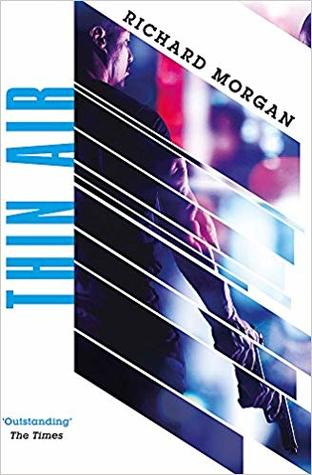
Thin Air - Richard K. Morgan
Thin Air is a new sci-fi novel from Richard K. Morgan, whose
Altered Carbon was recently made into a hit series on Netflix. Much like that
work (and indeed, Morgan’s oeuvre as a whole), Thin Air combines some
scintillating, imaginative ideas with unapologetic violence and, whisper it,
more than a little sex. This is science-fiction as neo-noir thriller, with
gunfights, multiple shadowy agenda, and blood on the floor keeping bums on
seats. But it also wants to be something bigger, letting the reader see a
society teetering on the edge of something, between corrupt officials and broken
heads. It shows us a system of the world which is broken, and whose members
simply accept that as the way it is – and the consequences of their acceptance
are there in the hackers diving into government systems, in the casual divide
between a dominant elite and everyone else, in the drops of dark blood staining
the fibres of a luxury carpet.
But is it any good, though? If you’re a returning reader of
Morgan’s sci-fi work, I’ll make than an immediate yes. You can slip into the
Martian domes like a pair of comfortable shoes, following along with a worn out
antihero who has Done Some Things, and hit the ground running. The writing’s
still like you remember – taut, razor sharp, unflinching. If you’re coming to
Morgan through this book, I think it’s still a fast-paced, compelling read.
This is Mars. It’s no longer a pioneer world. There are
cities under the domes, and geological engineering continues. If there aren’t
the thriving urban areas of earth, there’s still two cities under distinct
political banners, with their own satellite towns. Still dependent on the
veiled might of earth, the regime that manages one of these cities is laissez
faire, prepared to do a lot to keep the eyes and ears of businesses big and
small, and also astonishingly corrupt. A Mars that believes anyone can pull
themselves up by their bootstraps is our stage, even if – perhaps especially if
– that isn’t true. The action slides between the opulent mansions of the
ultra-wealthy and the holding cells provided for those who disagree, staffed by
cops who take their money and, if they’re still willing to ask questions, are also
prepared to forget the answers.
This is Mars. A world living the slogan that
what they make is better, driving a revolution of small startup businesses, the
system crushing those who fail, those who succeed drawn into the web of favours
and extortion. This is Mars. A world - a
*world* - of barren plains separated by
these areas of human habitation, of hope in the face of hostility. Where
everyone knows everyone else is on the take, and is looking to make their cut
as well. This is Mars. It’s beautiful, and riven with social, political, even
geographical issues. It’s a place where hope and a dream can carry you to the
heights of existence, and where one misstep will throw you over the edge into
madness and despair. This is Mars.
Our guide to Mars is Hakan Veil. Veil was a monster come to
life, a corporate killer. Now he lives on Mars, washed up, dreaming of
returning to Earth. Veil makes for an interesting read. He’s obviously a smart
person, and his internal monologue backs that up – filled with plans, counter
plots, and moves within moves. That he can back that intelligence and tactical
sense up with an urge toward violence is a bonus. If Veil is out of his depth,
it’s because he’s fallen into some very deep waters. Still, this is the voice
of Mars – cynical, invested in a system which he doesn’t believe in, knowing
everyone has an angle. Veil is fast and deadly, but carries some undertones of
vulnerability. He’s not a killer with a heart of gold, but still someone who,
given the choice, would do the right thing. Quite what the right thing is may
depend. Veil is loyal to his friends, and prepared to go to extremes in service
to a goal; not a zealot, but a potential monster, shaped by circumstance,
holding back the tide with good-will and epithets.
If you’re here for the action, Veil can work as a power
fantasy. Almost inhuman in speed, precision, ferocity, he’s the black-ops
killer that everyone wants and no-one needs. Like the man himself, the prose in
Veil’s fights is almost too fast to see, as you’re turning the pages to follow
each weave, each dive, each crack of the gun. Veil could be too much, too far,
but he carries the truth of his humanity too. People who owe favours, yes.
Enemies, absolutely. Friends – a few. There’s an introspection here, a
fatalistic streak too. This is someone willing to pay the cost of their
actions, with an exhausted line of melancholia which weaves right through the
neo-noir environs of the Martian city. Veil is a hardass, and that’s a fact.
But he’s old, tired, a veteran of other people’s wars. Morgan succeeds in
bringing Veil to life for us, in showing that what happens after you make a
stand is just as important as what came before. Veil lives and breathes, as
much as Marlowe or Gittes ever did.
Though this is Veil’s story, there are others of course –
government functionaries. Peacekeeper’s ,straddling the line between pragmatism
in the face of power, and open corruption. Criminals – hackers, sneak thieves,
con-artists, outright idiots. Religious maniacs, and those who give populism,
nationalism and identity a voice.
As an aside, I've argued before that women don't always get the greatest space in Morgan's work, and that's nicely averted here. There's women at all levels, assisting or causing trouble for Veil as their needs permit. Police captains, black-bag agents, misguided gangers, politicians. It's nice to see some diversity at play here. It's nicer still that these agents of power and authority, in and-out of narrative, have their own schemes, their own needs - they're not here for Veil, but perhaps in spite of him. The book is all the better for it.
Anyway.
There’s a lot going on in this book.
In some ways it’s simple. Protect the client, get paid, go home.
If someone has to get shot along the ay, that’s a shame. But things aren’t that
simple. Layer upon layer of concealed meaning wraps the narrative, as we try
and work out who’s double crossing who, and why. If you’re here for the
gunplay, there’s a lot of it – tight, kinetic prose mixed in with splashes of
blood, and the cordite smell of the consequences. But there’s politics here
too, wrapped in obfuscation and mystery -as Veil tries to work out what’s going
on and why, and we come along for the ride. There’s larger causes, and those
intertwine with the personal needs of a man who isn’t entirely sure what he
wants – or needs – any longer.
In any event, there’s a lot going on. I love the Mars we see
here – riven by factional politics and suffering under the leeches of
corruption, it’s still a vibrant and distinct culture. Indeed, those things –
and the upsurge in nationalism and independence – are part of the Martian
culture. I have a lot of time for Veil, an action hero brought out of
retirement, too tired to deal with any of the nonsense that the world keeps
throwing at him. And the plot will suck you in and keep you trying to figure
out where it’s going, and how it’s all going to end.
Does it work? Yes, I think so. There’s sex and violence
aplenty, but it doesn’t feel over-done; it’s merely a part of the world. There’s
a story which invites you to invest in it, and will reward you for doing so,
filled with complex characters in a difficult, living, breathing world. If you’re
in the mood for some fast-paced sci-fi, or ready to dip a toe into a noir novel
of the near future – then I can recommend this one wholeheartedly. Once you’ve
picked it up, it’s pretty much impossible to put down.
Wednesday, September 26, 2018
Salvation's Fire - Justina Robson
Salvation’s Fire: After The War is the second book in the
‘After the War’ universe; the first, by Adrian Tchaikovsky, having come out
earlier this year. This book follows on from the events of the first, but it
can be read as a standalone – though you may lose some useful context by doing
so.
This is the world after the end. After a dark threat has
arisen, raised its armies and broken them against heroes. After the darkness
has seeped in and poisoned the soil After the darkness has killed the Gods.
After it has shaped a new world, one which necessitates co-operation and incentivises
action. The great villain drew peoples together even as he broke them. In their
shattering, they recombine into a stronger whole. And this book is part of that
process. The war is over, that’s for sure. But remnants of the past are
difficult to shift.
There’s a sense here of spaces in recovery. Things are
quieter, perhaps, than previous. Though there are still the poor, the
destitute, the wandering remnants of armies, these things are less visible than
before, though still a factor. This is also a world coming to terms with a lack
of religion; in a space where the gods have been active and real, and where
their servants and avatars have been embedded in the day to day, life without
them is a complex, difficult, damaging work in progress.
We wander forests – only some of which are on fire – and seas
here. There’s the opportunity to catch up with several cultures, and delve into
the harrowing depths of the broken citadel of the enemy. The description is
tightly written, giving enough detail to set the reader’s imagination to
filling in the blank spaces. It avoids baroque prose and gives out what it
needs you to know, and invites you to fill in the remainder. This builds a
living, breathing world from the struts of the narrative – though yours may
look different to mine, they carry the same story. The world breathes, its
denizens living, suffering, hopeful creatures, its locales a smorgasbord for
the imagination.
What I’m saying is, if you came here from the first book in
the series, the world will feel familiar, but with enough differences to make
you sit up and take notice. If this is your first step into this space, then I’ll
say this: the depth and complexity of the world on display is impressive.
This is more of an ensemble piece than the last book. Though
there are some old favourites, there’s enough new people around to keep us
guessing. Celestine, slayer of evils, whose search for redemption defines much
of the series so far, is still here. She’s still tired, still questioning
herself, and still unwilling to take any crap from any of the various gods,
monsters and everyday idiots that cross her path. Celestine kicks arse, in
between worrying about what she’s doing and why – which makes her feel rather
human, in her competences and her doubts.
There’s a focus here on Kula, one of the newer members of
the group; a girl who has very little, and now has to decide exactly what she wants.
Watching the other members of the team – demi-gods, old monsters and struggling
heroes all – try to interact with a young girl is a delight, exposing as it
does some of their own troubles, and the darker secrets beneath the
personalities they put out for public consumption. Kula is thoughtful, strange
and frightened, and those attitudes seep off the page as you turn the pages –
and as her understanding of her purpose and that of the team grows, sodoes
yours.
At heart this is a character piece webbed into an ensemble
adventure. Fortunately the characters are convincing, crafted with a precision
which leaves them stepping off the page to pick up a snack and ask when youre
getting to the next chapter. As an ensemble, they work well together, the
conflicts and bickering keeping the wheels going, and a sense of deeper issues
acting as a shadow over the lighter moments.
Another new arrival carries a wonderful dichotomy about them
– in things they have done, actions performed, regrets created. Yet they live
and laugh and love with an energy and passion which belies that quieter
emotional flow beneath. I won’t go into details for fear of spoilers, but rest
assured – these are people, and their struggles and triumphs, losses and hopes
will compel you to find out what they do next, and what choices they make.
The plot – well, I won’t spoil it. But I’ll say this. It has
moments which are truly epic, struggles which are also spectacle. It has
moments of heart-rending sorrow, of people making appalling, difficult choices.
It has some wonderfully dry wit in the dialogue, which made me chuckle, and
some sting that made me bleed as I turned the page. It’s got individual
stories, moments of personal growth and suffering which show us individuals
shaping themselves, and it has explosions of magicn and power which (also)
shape worlds.
This is a clever, vivid, cunningly crafted work of fantasy,
one which moves from the personal to the epic and back with swift, assured
prose. It’s a good story, and one which will make you think in between seeing
what happens next. Give it a try.
Subscribe to:
Posts (Atom)