Wednesday, July 27, 2022

All The Seas of the World - Guy Gavriel Kay


Regular readers will know I'm a huge fan of Guy Gavriel Kay. His lyrical prose, and careful blending of a slightly alternative historical reality with just a soupcon of the different, the magical, well, it's a joy. Every book manages to make me think about life in a different way, and each book manages to make me feel, deeply, as I fly through its pages. All The Seas of the World is no exception. It's a book with a story that'll keep you turning pages late at night to find out what happens next, but it's also more than that. It's an opportunity to think about the role of small decisions and coincidences, and the way they shape lives. It's an opportunity to think about the ripples our steps cause in the lives of others. And it's an opportunity to explore agency, the way we act on the world.  This is a story which, amongst other things, wants to explore the nature of lives and stories, the way the tales we tell ourselves and others are intertwined into a complex web of different expectations and understandings, and common ground between.

Anyway. That's all to say this is a book which manages to balance several plates; not just ponderously ruminating on the human condition, but doing so as flashes of lightning across the sky of a narrative that, well, it does a lot, from assassinations and coups to business ventures and sieges. 

In terms of world: this is set in the same world as many of Kay's other alternate-history tales; in this case it feels a lot like some of the early renaissance republics of Italy, with the serial numbers filed off. There's that sense of a mercantile class shifting around the boundaries of aristocracy. The feeling that the centres of power in the world are shifting. The sense that identity is becoming more mutable, perhaps. Or perhaps not. One of the things the book does is dive into the idea of home, and of self, and whether people are the culture they were born into , or the one they were exposed to, or if they shape themselves under or outside of those pressures. It also looks at the costs of breaking with established homes, of walking away from situations as they get out of control, and the costs that come with staying to struggle under the weight of those situations as well. Many of the characters here are trying to decide who they are, in one way or another, and in trying to define and decide that, they shape not only themselves, but a broader conversation. 

In any case, the world is a lush, rich, baroque one. Kay's vivid prose fills it with life and energy, and a wry humanity, voices filled with affection, violence, horror, joy, passion, love, and, from time to time, outright stupidity. The world lives and breathes and fights and builds and burns and shines on the page. From the soaring stone buildings of an ersatz Republic, to the sun-drenched cracked flagstones of border forts on the boundary of states in a cold war turning hot, there's an energy and a life that makes the backgrop feel like a living world, one that feels real. 

The same applies to the characters, honestly. I don't want to dive inot them in detail, in part to avoid spoilers. But it's always nice to see Kay approach larger issues tangentially, through the eyes of characters who live alongside great events and people we remember from history. This is a story about people who aren't central to the "great individual" theory, but whose choices matter, whose lives matter, whose humanity matters. There's a central duo here, and it's always great to see a well-drawn female protagonist, and some solid minority representation on the page. The pair are smart, and by turns smart, funny, serious and deadly. Really, they're everything that people are, especially people pushed to find their limits and their boundaries in the face of unexpected threats and opportunities.

The story itself is a complex set of interwoven threads, tying characters together half a world apart, or right next to each other. There's murder, mystery, and more than a little mayhem. There's a dash of romance mixed in there, and some lovely platonic interaction by people who give a damn. Chases and battles of wits and unfortunate coincidences and serendipity and blood on the floor and gold in the hand and passion and laughter and tears and, well, life. 

This is a damn good story, and if you're an existing fan, it's a damn good Kay story. Go get it.


Wednesday, July 13, 2022

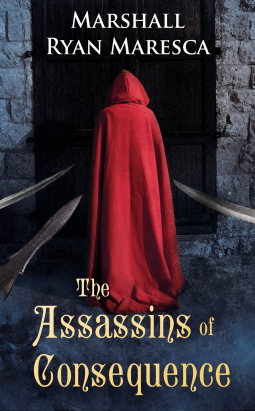
The Assassins of Consequence - Marshall Ryan Maresca


Marshall Ryan Maresca's Maradaine series started with "The Thorn", a university student turned vigilante, with something of a murky past. The series quickly broadened in scope to follow multiple characters in stories of their own, from working beat cops to literal knights in shining armour. But Veranix was the first face of Maradaine. It's fitting, therefore, that in The Assassins of Consequence, his be the first story picked up after the explosive events of the last book, which brought all the various characters together, and lit a fuse. The consequences of the following explosion in the metaphorical fireworks factory are reverberating through the world of Maradaine - and through Veranix. 

This Veranix is a mixture of the familiar and the strange. Always a little cocky, he's now trying to risk less, to keep himself and his friends as far out of trouble as he can, while also fighting crime, scowling broodingly from rooftops, and, oh, yes, being a magic student at the university. The university, incidentally, has recently had its magical programme taken over by what passes for a branch of Maradaine's military intelligencee service. Quite why, is another matter entirely. But in terms of chracter, the change dislodges Veranix from his comfort zone. It puts academic pressure on him, it puts demands on him that come backed with social legitimacy. While he's inching closer to his goal of bringing down organised crime boss Fenmere, he's doing so with other pressing calls on his attention. Our superhero is growing up, and not only finding out that heroism has costs, but that both he and others will be forced to bear them, whether they will or not. The text does show us the Veranix we know, in witty banter, athletic leaps from rooftop to rooftop, and daring escapes. But there's a pensiveness, and moments of introspection that suggest the Thorn is more troubled than before, more drawn to being, well, Veranix.

There's some excellent turns by Veranix's gang of do-gooders as well. They're all hanging together, trying to work together to make things better. But they're all pulled by conflicting priorities, loyalties, and their own needs. Sometimes, fighting the good fight in a cape isn't very rewarding, and sometimes you might get appalled at the costs, in life, treasure, and humanity. As a group, Veranix's support team are a joy - each a fully realised individual, with a story

The villains are entertaining, though I must confess that in this case there were rather a lot of them. Fenmere, always the overarching threat, and a host of Veranix's past conquests, getting the band backl together in a jailbreak to go mess him up. And rumblings of others still to come. They're fun to read though, seeing the other side in the vein of Suicide Squad. There's enough moments of humour and humanity to help them not just feel like ciphers, even if the narrative focus is on their grudge, and their scheme to finish it - which, incidentally, includes identifying Veranix, and feeding back into the question of who the man who is The Thorn would be, if he didn't have The Thorn to be any longer.

I won't speak much on Maradaine the city, because I've waxed lyrical on it before. Suffice to say it remains a vibrant, living world. There's ahistory there that you can feel in your bones. And if we don't see as much of it this time around as we have before, we still have the flavour and colour in asides and moments of reflection. Maradaine lives, friends, Maradaine lives. This time it lives in its slums and dockhouses, worn down inns and flashing knives. It lives in its quadrangles and literal walled gardens. In faculty meetings and gang interrogations. It's aplace, still, with depth, and weight.

Anyway. Is it good, then? I don't want to spoil the story, because this one is laced through with turns, twists, chases, escapes, derring-do, moral crises and just plain old crises. I will say that I read it quickly, that I wanted to get to the end and I didn't want it to end. It's maybe not an ideal option for your first Maradaine book (but don't worry, there are lots of entry choices!); but if you're a regular reader, this one is going to follow you around the room. It's great fun, and a great read.


Wednesday, June 29, 2022

Braking Day - Adam Oyebanji


Braking Day is a sci-fi novel by Adam Oyebanji. It takes place across a small fleet of generation ships, as they come to the end of their journey. Soon, they're going to reach the point at which they beign to slow down ("Braking Day), and prepare to enter and colonise a new star system. But before they do, there are going to be some dark answers given to hard questions. Old mysteries are going to be dug up and dragged into the light. The survival of the society on the ships, indeed the survival of the ships themselves, may hang in the balance.

And the feather tipping that balance is a young man who just wants to be left alone, left to do his job in peace, to maybe get a promotion, to maybe change things a little. He may get rather more than he's bargained for. 

All of that sounded rather portentuous, so to save you a longer read, the tl;dr is that Braking Day is a fun, snappy sci-fi yarn. It builds out a believable inter-generational society for its ships, one which has genuine problems baked in, but isn't a theocracy or raving anarchy. It shows us young, smart people trying to do the right thing, and older, debatably as smart people whose perspective on what the right thing is may differ. It explores social class and asks questions about wha we choose to remember and to forget.But in etween the big questions it has a fast-paced action adventure story going on, with a delightful soupcon of mystery about it.

Our protagonist is Ravi Macleod, an officer candidate on one of the ships, and from a family that are very much the wrong side of the tracks. He suffers from discrimination on one side, and from disappointment on the other. His fellow students think he's a criminal, and his family aren't entirely sure he's not becoming just another member of the elite looking to put them down. Ravi, through it all, is thoughtful, conscientious, and perhaps a little prone to being led by his emotions. He carries his flaws well, though, and the story gives him the chance to be articulate and likable. If I was occasionally driven to a shake of the head at a moment of naivete, still it was possible to feel an honest joy in those moments as well, to see someone reaching out for the better option, rather than the least worst. Ravi is an excellent portrayal of a young man stepping out onto unsure footing, looking to find something of himself between the metal walls that he calls home. And he's helped by a rather fun ensemble cast. Honestly, I wanted to see more of all of them, but a shout out in particular to his cousin Boz, a young woman with a word-weary attitude decades odler than she is, but with the fire and ideals to try and make change and break things whe needed. She's an excellent foil for Ravi, and their interplay of outlooks was always a genuine delight.

They exist on one of three generation ships, creaking, much repaired vessels sailing the wine-dark sea of space. Those craft have seen their shar eof triumphs and tragedies etched inot their skins, and we see a lot of references to their history, both implicit and explicit. it's a credit to the author that the Archimedes, Ravi's ship, feels like a real, lived in space. From its battered duct-work to lost compartments, from the engineering core buried levels deep to the bar-slash movie theatre the kids go to, the environment has a humanity to it, an energy which says that this is a real space. Some of that is georpahy played out as politics, too; the tensions between a class of semi-hereditary officers and those beneath them is often palpable. Those at the bottom of the ladder are a few bad choices form being stuffed into the recycler as biomass. The ships feel their age, feel like decisions have been made there, catastrophes and triumphs all - and the socity they've built feels human too. Laced through with flaws, open to corruption, someimes driven by poor or terrible choices, but in the end, something built by people trying to do their best, trying to survive.

And the story. Ah, well, no spoilers. But this one went places I didn't expect from the jump. It's one part mystery, one part coming of age tale, one part adventure epic - and you know what, all of those parts are rather good. Importantly, it asks big questions, human questions, which will make you think - but it asks them while you're having so much fun following along that you may ot notice for a little bit. 

In summary, it's a fun story, with interesting things to say, with solid characterisation in a well-drawn world. That makes it a solid purchase, if you're in need of a generation ship mystery (and who isn't?!).

Wednesday, June 15, 2022

Kingdoms of Death - Christopher Ruocchio

Christopher Ruocchio’s Kingdoms of Death is the fourth in his Sun Eater series, centred around Hadrian Marlowe, a knight errant, an occasional politician, an excellent strategist, and someone who looks sceptically at their own legend. Marlowe lives in the bounds of an Empire of Man, where the gene-modified aristocracy live over generations of their subjects. Where Roman and monarchial cultural trappings live cheek-by-jowl with starships pathing the dark distances between the stars. Where legions of sword-and-laser wielding legionnaires spend centuries in cryo-sleep on troop barges before landing in the face of the alien or transhuman menace. 


Marlowe has seen more of that menace than most. He’s seen the shifting madness of transhuman technophiles, whose consciousness, skipping from body to body, seems to have lost something of its humanity in the process. He’s seen the raw tentacles of ancient, caged AI, lashing against the bars, speaking in a thousand tongues of the future and the past. He’s seen the shadow government of his own Empire, the inquuisition that seeks to cut out corruption, alien or human, brutally and swiftly, often in ignorance.And he’s seen the beasts that stalk the stars, the alien, the Cielcin.


*** Potential spoilers past this point ***


The Cielcin are the focus of a lot of this book, and, fair warning, it is a big book. Marlowe explores both Cielcin society and his own limits. Brought into the depths of their world as a captive, he’s tortured, abandoned, experimented on, tortured again. In suffering their may be some measure of truth, and that’s doubly true for the reader. We can see Marlowe pared down to his core, stripped of rank, position and indeed clothes. Left to die, or not, left to live, or not. To go mad, to decide his own fate, or settle on his own sacrifice. 


The Cielcin are not gentle on prisoners, no. Mostly, they eat prisoners. But Marlowe, him they have other plans for. The society we see painted out before us is one that is uncompromising, brutal and ancient. It has ritual and faith in its own fashion, and within their own lights, the Cielcin are in the right in their struggle to, well, eliminate humanity and use them as food.


 The author shows us that society in all its grotesque, near-human horror - from the military parades and processions, to the vicious dance of lethal politics, to the banquets on the flesh of men, and back around again, to the cultured leader who can sit and hold a nuanced dialogue, and break a subordinate with a word, can order atrocities without a qualm. This is a society that feels genuinely alien, off kilter, different to our understanding - it exists slightly outside our frame of reference in its strange familiarity. And the writer has made this work, in its magnificence and horror - so kudos. You really do feel dipped, all unwilling, into a ferocious and alien society, one which operates by its own rules, and doesn’t look on humanity as potential partners as much as threats or a food source. This is a universe with a dark mysticism and a strangeness, laced through with the baroque terrors and wonders and fragility of humanity. 


The world building, in other words, is superb. 


The character work is of a similar quality. I’ve touched on the alienness, the uncanny-seeming nature of the Cielcin. But we also spend a lot of time with Marlowe, inside his head, as he slowly breaks down, breaks away from the trappings of himself. In his suffering, depression, possible madness over years of Cielcin captivity, he gains something in self knowledge, something in understanding of the world and himself. He also gets quite a comprehensive journey through pain, desolation and suffering. But the journey, from Hadrian the knight, the killer, the once-hero of the Empire, down to Had the man, the person at the core of the outer whirl of values and worries, what remains in extremis, that journey is a long and sometimes insightful one. But it’s also a dark one filled with blood and tears and truly wretched horrors, and so I say be warned - but also, that in terms of characterisation, this is pitch-perfect, this gives us a chance to sit with Hadrian, to see him as he is and as he sees himself change, and we wrench and fall and sympathise and empathise with him as he struggles against his own desecration and diminution. Will things get better? You’ll have to read the book to see, but Hadrian, him came to know right well. 


The story, well, in many places it’s meditatively paced, slowly steeping the reader in the gentle and pervasive atrocity of horror in which Hadrian finds himself immersed. But there are moments of pure joy here too, moments of glinting starships trading fire, glimpses of heroism and personal sacrifice to make you weep. There’s snappily-drawn, uncompromising combat, both the tactical surge of laser fire, and the razor-edged, bloody tear of blade on blade. There’s time for love, too, and the kind of friendship and comradeship that can make your chest ache with it. Basically, this is a damn good story, hitting all the right notes - and one that will reward long time readers and leave them asking for more. 


It’s a very good book, an excellent addition to the series, and you should definitely go and pick it up


Wednesday, May 4, 2022

Back soon!

 Schedule is going to be off for a few weeks as we're moving house and that is...exhausting and hectic. 

But we'll be back soon!

Wednesday, April 20, 2022

Born For Trouble: The Further Adventures of Hap and Leonard - Joe. R. Lansdale


Born for Trouble is a collection of novellae and short stories in the universe of Hap and Leonard, issued from the pen of the prolific and always hugely entertaining Joe. R. Lansdale. Those of you who follow this blog on the regular will know that I’ve been a big fan of Hap and Leonard, and their various misadventures, for years. Getting another slice of East Texas mayhem and found-family affection is always a treat. And so it proves here!


I will say that if you’re a fan of the series, this is likely going to hit the spot for you. A newcomer will find it accessible and entertaining too, but might be advised to dig into the larger series as well. But either way, the crux of the thing: what is it, is it well written, do I want to spend money on it?


Lets start at the end. Yes. If you’re looking for more Hap & Leonard, this is going to meet your needs. Opening it up and reading through the stories, filled with warm banter, cold violence and a sense of place that you can feel in your bones…well. It’s like slipping into a pair of comfortable old shoes, which…may also happen to be a little bloodstained. 


The stories themselves are, well, delightful, in the way they blend the weird and the prosaic. The way they bring to life a Texan swamp jungle in one breath, filled with predatory animals and people, and in the next ask us to consider the mundane, intimate absurdity of tracking down a lost stuffed dog. Though that one does go somewhere rather unexpected, come to think of it. In any case, they’re the sort of stories I’ve come to these books to read. Filled with a low-key camaraderie from the leads, a kind of low-key simmering energy which makes their loyalties and joy in each other obvious, while also not being afraid to let them run their mouths and give each other crap in an endless game of fat-chewing. Filled with vivid descriptions that manage to ensure that particular neck of Texas feels alive to me, feels real  and is unflinching in showing off the horror and the death in it, but the beauty as well. 


And the plots have that blend to them as well. From a dead child in a bookmobile, to the aforementioned stuffed dog, to the stalking of a psychologist - there’s no turning away from the reality of crime, or the sordid nature of much of its motivations. But it’s never unfair - you always know as much as the protagonists do, and if you’re as baffled as they are, well, that’s probably just as well.And the stories themselves…well, they’re Lansdale in fine form. Smartly paced, they’ll keep you turning pages. But they’re also clever, twisty, a little dark, sometimes surprisingly poignant, and usually able to elicit some genuine laughter too. Because they’re looking at people, at Hap and Leonard, and also at all the folks around them, their family, their friends, and the psychology of the people and events they’re looking into. 


I don’t want to touch too much on the boys themselves here. I will say that Hap and Leonard’s genuine affection for each other, a friendship that seems to have long ago swerved into brotherhood, is palpable on the page. And it makes me happy to see that kind of relationship brought to the fore - two men working side by side, sharing hope and loss and dreams, and managing to do it without being appallingly toxic. They’re good lads, those two, and the heart of every story is the way they know each other. Which isn’t to say there isn’t some shit-talking and some very hurtful remarks about vanilla cookies. But still. It is worth noting that the boys themselves remark on their getting older, and Hap, at least, is starting to feel the effects of the pressure of their adventures - and it’s wonderful to see these stories look unflinchingly at depression, at trauma, at the costs of violence - and do so in a way which still feel real and human. 


Which isn’t to say it’s all doom and gloom. Far from it.in the end, these stories are fun. They’ll make you feel, though, and no shame in that, cry and laugh while you try and figure out what the heck is going on, and then nod knowingly when the criminals are revealed or comeuppances are issued. 


So, to circle back toi the point I drifted off of up there: what is it? It’s more Hap & Leonard. Is it well written? Yes, yes it is. Should you buy it? Abso-bloody-lutely. 


Wednesday, April 6, 2022

The Girl and the Moon - Mark Lawrence

Okay, so The Girl and the Moon. What is it? Well, it’s the concluding novel in Mark Lawrence’s The Book of the Ice trilogy. And it’s also bloody brilliant. 

That reaction probably isn’t a great surprise to most of you, who know I’ve been a fan of Mark’s work for quite a while now. But I want to emphasise it again, for those of you nodding along and saying “Yeah but you like everything he writes”. Yes. Yes I do. It’s intelligently written, with complex characterisation which builds complicated, human characters out of hardship, friendship, and the occasional bout of violence. It’s written with an eye to a world which makes sense, which is rich in detail, which has a history that we’d love to see mor e of, even as we soak up the grandeur, strangeness and similarities unrolling in front of us. And it has stories that make you want to keep reading. That last one, perhaps most of all. It blends together characters and world and story into a delightful narrative gumbo, one which it’s impossible to stop eating. I mean reading. 


And all of those traits are on display here. Yes.  But this one is a stunner, even by the usual high standard for Lawrence’s work. My initial review was just a line that said “I was up until one-thirty in the morning reading this, and I have no regrets”. That is still very true. And I have every expectation that if you’ve come along on the journey of Yaz and her friends, as they trudged through endless ice, through the subterranean husks of haunted worlds, and through the under currents of their own understanding…well, then you won’t have any regrets reading this, either. 


I will make one caveat: this is the final book in a trilogy. There is a summary of the previous two books at the front, so if you haven’t read the first two in a while, that’ll brush up your memory. And if you haven’t read either of them, you could probably use that summary to come in and not be entirely lost. But really, if you’re new to the series, go back to the start, you won’t regret it. 


Which is a whole lot of words just to say, this is a book that anyone invested in Yaz’s story, and the world of Abeth, should read. But you should. Go get a copy!


I don’t want to mine too deep, for fear of spoilers, but let’s talk a little bit about Abeth. It’s a world we’ve seen before (in the Red Sister series), but mostly the nicer, sunny bits, filled with politics, magic and murder. And then we’ve had The Book of the Ice, which has been filled with a lot of, well, if we’re honest, ice. And also some magic, and, yes, sometimes a murder. But we’ve seen characters moved out of their element, seen them adapt, work together, understand each other, and push forward together. Here, they’re doing something a little different - stepping into a climate that isn’t trying to kill them, and into a society which operates by different rules, and may well, in fact, try to kill them. The sense of personal connection and social disconnection is done beautifully, as our intrepid band rapidly find themselves out of their depth. They have each other to rely on, but they don’t know the rules, and they don’t know how to survive in a world which isn’t bounded by the necessity of subsistence survival. From a characterisation point of view, this is beautifully done - watching new bonds form, watching each of Yaz’s friends, and Yaz herself, struggle with the idea of abundance, in even a transient sense. Watching them try to understand what it is that drives people with so much to do some pretty awful things. And it also says to the reader, I think, that these strangers in a strange land, they’re not stupid, or bad, or wrong in their strangeness, they just operate in a different context. Something we could all stand to think about in our own lives, perhaps. 


It’s great to see Yaz taking the lead here, a woman who has really been growing into herself. Deciding who she is and what she actually wants has always been a struggle, and we’ve seen that before in the fragments of “devils” that she’s encountered, broken pieces of their former selves. But Yaz is taking hold of parts of herself and examining them, holding onto them, making her sense of self something she shapes, something not defined by the expectations of those around her. That’s a powerful message, and one that will resonate strongly with a lot of readers. And, to be fair to Yaz, she does this while also kicking some serious butt, getting an understanding of her own emotional vulnerabilities, planning to save the world, and making new friends. Basically, Yaz is awesome. And she’s backed by an amazing supporting cast, from nefarious unspeakable ancient evils, right through to the mechanised spirit of a teenage ancestor, and out the other side to familiar faces from the ice plains. And she’s going to meet more than a few new friends and enemies in this story, too (and there’s some connections into Lawrence’s other work, if you’re paying attention).


Anyway, I’ve gone on long enough. 


Yaz is great, a protagonist with a fascinating perspective, and with energy and resilience that makes her a pleasure to follow along with. Her fellow cast add excellent flavour to the stew - as does Abeth itself, a rich world with a diverse, multi-layered history which I’d love to explore further. And the story, as I said way back at the start of this review, was one that kept me up until waaaaay too late. It kept me turning pages, and it’ll do the same for you.


So we’re back to the top, and the big question is, should you read this? Yes, yes you should. As fast as you can!