Wednesday, March 8, 2023

The Bloodstained Shade - Cass Morris


I'm going to say up front that I think Cass Morris is an author who I think deserves more exposure. Her dialogue is snappy, her descriptions always give you enough detail to build out a lush, intriguing world without being overwhelming. Her characters feel like people, with real thoughts, feelings and oh my opinions of their own, and her stories have that elusive capacity to keep you turning pages to see what happens next. I've been talking about her work for years now, and I really, really want the tl;dr of this review to be: this is an excellent book in an excellent series, and you should go now and read both. 

With that out of the way, lets move on to The Bloodstained Shade in particular. Set in the alternate history of Aven, a Rome where magic is very real, and where mages exist throughout society, the narrative focuses on Latona of the aristocratic family Vitelliae, as she attempts to unravel an apocalyptic conspiracy at the heart of the city's government. It does also venture further afield, into warfare and diplomacy with other peoples out in the provinces, with Sempronius, a man who leads legions, does so rather illegally by being a secret magic-user, and does both of those things while being in love with Latona. But while we do get chapters from his point of view, and while I always enjoy the kinetic, fiercely physical feelings of tension that the author brings to her battle scenes, the focus of the story feels more tightly on Aven and environs than in other volumes of the series.

Fortunate, then, that Aven, the city, is a star all its own. From the graffiti-laden streets run by concerns of armed men, to the luxurious villas of the aristocracy, part sunroom, part fortress, to the austere, echoing halls of power that are the senate, the city has a grit, a grime and an energy that makes it feel alive. The same is true of the outskirts - the fields where returning legions camp, the quiet guesthouses whose hosts may or may not also be jailers. Therre's a vitality to Aven, a raw feeling of a melting pot on the move, that you can feel between the spaces of the words. That said, it's also a city in tension with itself; while diversity of peoples may ensure a better city, there's certainly people on hand who want to push back on that notion, to go back to the Good Old Days, which happen to have been good for them, rather than anyone else. There's an undercurrent of fear, of distrust, of wrestling with the pace of change. All concerns which may sound very familiar to the modern reader! Anyway, this is a long way of saying that there's texture and context to the world that Morris is building here. We known enough, even from a Hollywood history of Rome, to fill in some of the details, but what she makes explicit is exciting, intriguing, and most importantly, feels real. 

The same is broadly true of the characters. I don't want to delve too deep for the sake of spoilers, but I will say that Latona has grown, here/ A woman looking for a role, stepping out of the shadow of expectations of others, has found it and is now pushing at the boundaries of society around her. Pushing back with an ideal of decency and service to the good. That evolution is the natural culmination of two previous books worth of effort, and the character fills it out perfectly. She's confident in herself, but cognizant of and coping with the fractures running through her emotions, through the trauma in her past. Latona is a power in her own right, now, but she's a person, wrapped in as much nonsense and damage as anyone else - often considerably more. But she's capable of strength and virtue and, let us say it loudly, kicking butt. She's a great one to follow around. 

In this she's aided by a sterling cast of supporting characters, many of whom she's related to They all have their own agenda, their own needs and wants and desires and hatreds and loves. There's a delightfully gentle sapphic romance at one point that kept making me smile because oif both how awkward and how genuine it felt, and there's confrontations with antagonists that make you reel back in horror and long for the catharsis of their defeat. Incidentally, I want to say that Corinna, one of the main antagonists, a mage herself of no small distinction, is an excellent nemesis, a dark, broken mirror of Latona, someone as unwilling to accept the bounds society places on her, but perhaps even more willing to go further, to ends less salubrious. Every time she was on the page was a skin crawlingly evil joy.

And the story...again, no spoilers. But it ramps up well, pages of ratcheting tension keeping you going, dipping into battles and conspiracies and betrayals and revelation in equal measure. It's a story of women fighting expectations, and a story with magic in the air and blood on the floor. It's a story of government and grace. It's a story that you won't want to put down - and nor should you. Go read it, right now!

Wednesday, February 22, 2023

A Stitch In Time - Andrew J. Robinson


Probably to the surprise of no-one, I'm a huge Star Trek nerd. I'm especially fond of Deep Space Nine, which came onto the TV scene in the mid nineties, and helped shift the direction of science-fiction in television with its serialised format, lasting consequences, and tight characterisation dependent on relationships built over time. One of the better of those relationships was between the station doctor, Bashir, and a tailor by the name of Garak. Garak, a "plain, simple tailor" was the only member of the previous occupiers left on the station. He had a mysterious past, a penchant for arch, obfuscated, multi-layered commentary, and a wicked sense of humour. He may also have had something of a crush on the doctor, which was rather risqué for the mid-nineties, and never actively spelled out at the time. 

The actor behind Garak, however, Andrew J. Robinson, was always said this was the case. And he even wrote a book  in the franchise, centred on everyone's favourite tailor slash spy. That book, A Stitch In Time, went out of print very quickly, and was only available for ransom-like sums on ebay. But now it's been re-released on ebook, and audiobook, for relative pennies. And so, here we are, looking at a book by the actor, about the character he played for years, and whose performance helped personify that character and make them desperately, fantastically real. 

Which is all well and good. But what's the book like? Trek has a rather fraught history of quality control, after all. 

Good news. This is a very good book. 

The chapters flip between periods, from Garak's past into his present and back again, bookended by letters written to Doctor Bashir, back on Deep Space Nine. Because Garak is on Cardassia now, rebuilding a world broken and sharp with shards. Survivors of an occupying species, themselves now survivors of an occupation. What they'll rebuild is very much open to question, what their new society will be like. And what drives the people who lead this effort, how they get there, what they're willing or able to atone for, is something else entirely. And Robionson shows us all of that effortlessly. In Garak's interactions with shopkeepers, with doctors, with old enemies now old friends, and vice versa. With patriots and killers sifting the rubble for anything of worth, and with normal people who just want to remember, and rebuild. He shows us a Cardassia on its knees, trying to figure out where to go next, and makes it feel viscerally real, concrete, something you can put hands on, populated by people whose pain you can feel and wounds you can see. He evokes the idea of a war torn space perfectly, of the aftershocks of a conflict after the end has been and gone. 

And he also builds an excellent contrast with the old Cardassia, rigid, uniform, structured, arrogant and certain of itself. Garak's past holds up a mirror to the broken present, as the journey from one to the other builds to convergence. The two Cardassia's and the two Garak's are the same, but different, one older and perhaps wiser, but both speaking with the same voice. 

And what a voice it is. Robinson has fallen into Garak's rhythms here, you can hear the voice of the character from the show reverberating off the page. Sly, witty, charming, a driven liar and a patriot. I can't really dig into who he was, because the book does that for me. But the younger Garak feels a little less well-formed, but equally plausible, and his tone and voice shine through it all. There's an authenticity of language, a legitimacy of the prose that you rarely feel in franchise fiction. But here, the character sounds like themselves, and fits into who we think they are, even as they expand our boundaries of understanding. If the other characters are a little less rounded, so be it - this is Garak's story, and his view, and through that lens, we see enough. And it's enough to leave you delighted and heartbroken all at once, a portrait of someone on the edge of themselves. 

Anyway. Yes. This is a book about the past of one of Deep Space Nine's most mysterious characters. And it's revelatory in parts, and occluded still in others. And that's perhaps as it should be. And the future is touched on too, and again, not always clear. But there's a sense of hope throughout the text, and a sense of place, and a sense of, well, character, which made this a compelling, compulsive read. Even if you're not a Star Trek fan, this one is a cracking read.

Wednesday, February 8, 2023

The Ninth House - Leigh Bardugo


There's a lot of wizard school stories out there. The Ninth House is something different. Something with a lot more teeth. The sort of book that would jump Harry Potter in a dark alley with brass knuckles and a tire iron. And I love it for that. Because The Ninth House is here to talk serious business, but it's going to have fun and look good doing it. 

It's a story about magic. And about how the epicentre of that magic is, well, Yale. About how the young and wealthy spend themselves and others (mostly others) to  do impossible things. And how those things typically just happen to align with maintaining their own wealth and power. About how even if you give people the ability ot move through walls, or see the future, or change the weather, or create unbreakable contracts, they'll still mostly do people things with it, in a frenzy of patronising and self-aggrandising bullshit. The Ninth House knows most of the people in the story are terrible, and that's important - it wants to put a lens up against the structural underpinnings of both the magical school myth and our own society. And so here they are, the elite, doing magic to keep themselves that way, and being about as ugly as any street-level hustler while they do it, just with larger levers and a touch more self-delusion.

Maybe that sounds a bit grim. But what it really feels like is sharp. This is a story with a razor edge to it, one so fine you won't feel it until it suddenly takes your breath away. Because this Yale feels like a dream poisoned by our own hubris. The slumbering spires, the gothic elegance and opulence of the buildings, which help capture a lavish sense of place, also evoke a lavish sense of wealth and privilege. This is a small community which feels real, as it lives and breathes small scandals and petty grievances between teenagers with far too much power and money and nowhere near enough oversight. This is a Yale whose gatekeeping is real as well as metaphorical. The dive into blue chip money blended with old-school blood rituals is a marvel.

Speaking of oversight - that's why we're here. Our protagonist works for Lethe , the group tasked with keeping an eye on all the others, to make sure that if they're murdering homeless people while using them to predict the stock market, they at least do it quietly. Or, to be fair, not at all. Because nobody needs the attention. Nobody wants to ask or answer any questions, rock the boat, make things uncomfortable. Lethe is here to keep everyone in line, but is also complicit in keeping things comfortable. Their existence is dependent on all the other houses, all the other rich young things, relying on a balance of power and a need to avoid too much notice. And now, you see, there's been a murder. Maybe it doesn't matter. Maybe it does. Maybe it was magical. Maybe it wasn't. But Alex Stern, the newest Lethe adherent, is going to investigate it, at the very least so that she can keep her scholarship. And she's also not quite what anyone expects.

I don't want to talk too much about Alex as a protagonist, because her character is revealed slowly over the course of the story. But I will say that she fits the profile of the troubled, the traumatised, the person who assumes the worst because for them the worst has already happened. Alex is all brittle, sharp edges, leaving cuts on everything she runs into. She's smart, and funny, and deeply pragmatic and driven. And maybe held together like a shattered pane of glass, but a whole person, on and off the page. And that's fair for the supporting cast, too - some we see in more detail than others, but even the broadest brush stroke characters have some fine details that make you see them as people, as individuals. Granted, usually right before they do something heinous, but still.

So yes. This is, I'm unwilling to call it "magic school for grown ups". It's magic school with an examination of power, of violence and abuse and systemic oppression. Magic with a harder edge. Magic with teeth. And this is a book that'll sink those teeth in and not let go until it's done with you.

So go pick it up - what are you waiting for?

Wednesday, January 25, 2023

American Elsewhere - Robert Jackson Bennett

I've been reading this for a little over two years, since life got in the way. And it's beautifully written and bloody. And sometimes it dragged for me, and sometimes parts of it felt a little flabby around the middle. But a lot of the time it was eerie and bloody and thoughtful. A lot of the time it poked holes in things, and made you feel even when what it wanted you to feel was off-kilter, differently experienced.

And the last 20% is absolutely searing and very well done; it blends saying interesting things with doing that with interesting people, in, well, interesting ways. There's something there, behind the eyes of the story, and maybe it's hope.


American Elsewhere
is set in the town of Wink, a small, normal place at the bottom of a mesa, with a shuttered government facility at the top. But in the town of Wink, normal is never quite what it seems, and in fact is typically frequently far, far less. Wink is a town of compromises, of quiet arrangements and, possibly, faustian bargains. 

The normality of Wink is a veneer, a glaze that sits across the surface of the American suburban experience. That sense that something is off kilter, skittering just outside the corner of your eyes, that looking around a little too quickly is unwise. That there are not only untold stories, but stories best left untold - that's Wink. An eerie, ominous place that also fits into the space for perfection. It embodies the suburban dream, but in the way that shows the hollowness, the artifice. It works as a critique of the American Dream, but it also works on its own terms, as a slow roll of tense horror. An environment that papers over the cracks of life with promises and little, quiet words. And somewhere, in the edges of things, it's all starting to crack, to fall away.

And into that world falls Mona Bright. Law enforcement experience. Physically competent, sharp as a tack, and a mind swirliong around the worst edges of itself. Mona is coming into town to inherit a house, to try and answer a few questions about herself. Mona is in a liminal space, between worlds, between roles, holding close old tragedies and quiet moments. I think one of the small joys of Mona is being swept uo in her internal story, in the morass of feelings that make her who she is, in those moments between clarity, despair and joy. She's a hero, and also a person, a person doing their best under circumstances that don't entirely make sense any longer. 

And the rest of Wink. Oh my.  They're all simple people, quiet people. People who do simple things. Work on their cars. Throw parties. Meet their neighbours. But some of those people are living lives of extremely quiet desparation. And some of them are, possibly, living very different lives indeed. There's a...tension, at the heart of Wink. A lie, with people living it by choice, one way or another. Security, a price for sielnce, a price for living life as a dream, or in a dream. These are people, or people shaped, anyway.  They're eeerie and disqueiting these people, much like Wink itself, something rippling beneath the still surface waters.

I'm glad I finally finished this one; it's horrifying and strange in equal measure, and though I can't touch on the story for fear of spoilers, I'll say that you can feel its echoes in the days after you're done reading. This is silent, chilling horror, and a good read, too.

Tuesday, January 10, 2023

The Quarrygate Gambit - Marshall Ryan Maresca

I'm back, hand-selling the Maradaine Saga again. This sprawling epic is like the MCU of fantasy. Multiple different characters, all in the same setting, crossing paths, causing problems, solving problems, and occasionally uniting to take down the greater evils. There's a subseries for everyone - tales of vigilante justice, murder mysteries, heists. This is a story focused on the latter, via the Rynax brothers, Asti and Verci. Well, and this time, in The Quarrygate Gambitwith more than a little help from the women in their lives.

Because oh boy, have Asti and Verci got themselves into trouble. They've been packed off to Quarrygate, a prison that makes it a coin flip whether you'll ever see the outside again. And to add insult to injury, it wasn't even their own actions that got them there. Now they need to try and break out of maximum security, and find out whoi put them there and why - and then express some robust opinions on that topic. In parallel, Verci's wife, Raych, is putting together an unlikely band to figure out what happened to Verci, and perform a heist to pay for the help they need to pull him out of Quarrygate - if his own escape doesn't happen first. 

That sounds like a lot, and you know what, it is. This is a book which isn't afraid to hit the ground at pace. The characters are moving fast enough that they don't often have time to catch their breath. The audience, likewise, is pulled along in their wake, "just one more page" turning into the wee hours of the morning. I want to take a moment to shout out the really tight story, which flips between viewpoints fluidly, and doesn't waste time on ten words where one will do. It pulls you in with some wonderfully crafted hooks, then won't let go; everything is connected, and details feed back into the larger story in a way that rewards close attention. 

And the world, oh the world remains as meticulously planned and lavishly described as ever. Quarrygate is a hell, level on level on level of hard doors and harder men. Criminals of all stripes recidivists, alchemists, rogue mages, con-men, the occasional political. They're here, in between walls designed ot stop them causing any more trouble. The guards, with hard stares and brutally efficient security measures, are as much people as their charges. But the prison, the prison has a soul all its own, one built on years of screams in the dark, pleas of innocence and guilt, an institution grown uncaring in its lack of grace. It feels, not to put too fine a point on it, like a prison, like a place where you definitely don't want to end up. And in its institutional craftings, in its injustices unthinking, in its lights out times and checkpoints and deeper, quieter, deadlier sub-levels there's an echo of our own lives, too. In the way the institution eats people and disgorges them when it pleases, yes, that too. We can see an echo in ourselves. It's a wonderful bit of world-building. 

It's shared by the wonderfully lavish art gallery and shopping areas that Raych and her team visit for their heist. Where Quarrygate is bare stone, these are ornate draperies and statuettes. Brutal guards are replaced with obsequious but hard-eyed security. Cell doors with drop-bars and alarms , prisoners with patrons. There's a fascinating duality here, that suggests these are two sides to the same coin, the sharper shards of prison life peeking through the velvet ropes. The cost bourne to let artists and artistes live uncomplicated lives. But anyway. These rich towers and their inhabitants are just as much institutions as Quarrygate, but with a shinier coat of paint; and the glitz and the glam dazzles evcn as it doesn't distract from the riches within. 

We've talked about the Rynax brothers at length before, and what I've said there holds true again. They're smart, hard men, trying to put things behind them, put damage and risk behind them and live normal lives. But trouble just keeps on finding them. Watching them fight their pasts and their demons to win through remains a joy; but the unexpected star of the book is Raych, who takes the centre stage this time, not just a Rynax supporting spouse, but the mastermind behind a heist, put together with clockwork precision and a cool skill and ruthlessness her husband might envy. Raych fights out of love, and with that, all things are possible. Seeing her take steps to do what she feels must be done, finding things inside herself that she hasn't needed before, resources and talents dug up anew, it's a genuinely joyful experience. These are people, not players on a stage, their flawed humanity brought to bear to mirror our own.

Which is to say, it's a bloody good book. Greta characterisation. Great world-building. And prison breaks and heists and sword fights and espionage and double crosses and triple crosses and skulduggery and magic and, you know, general chaos. All that good stuff. Any Maradaine fan owes it to themselves to read this one, and if you're not a Maradaine fan, you should be.

Wednesday, December 21, 2022

Back in 2023!

 It's the holiday season for us. I hope everyone out there has a great holiday, and we'll see you at the start of 2023 for another year of reading and talking about it!

Wednesday, December 7, 2022

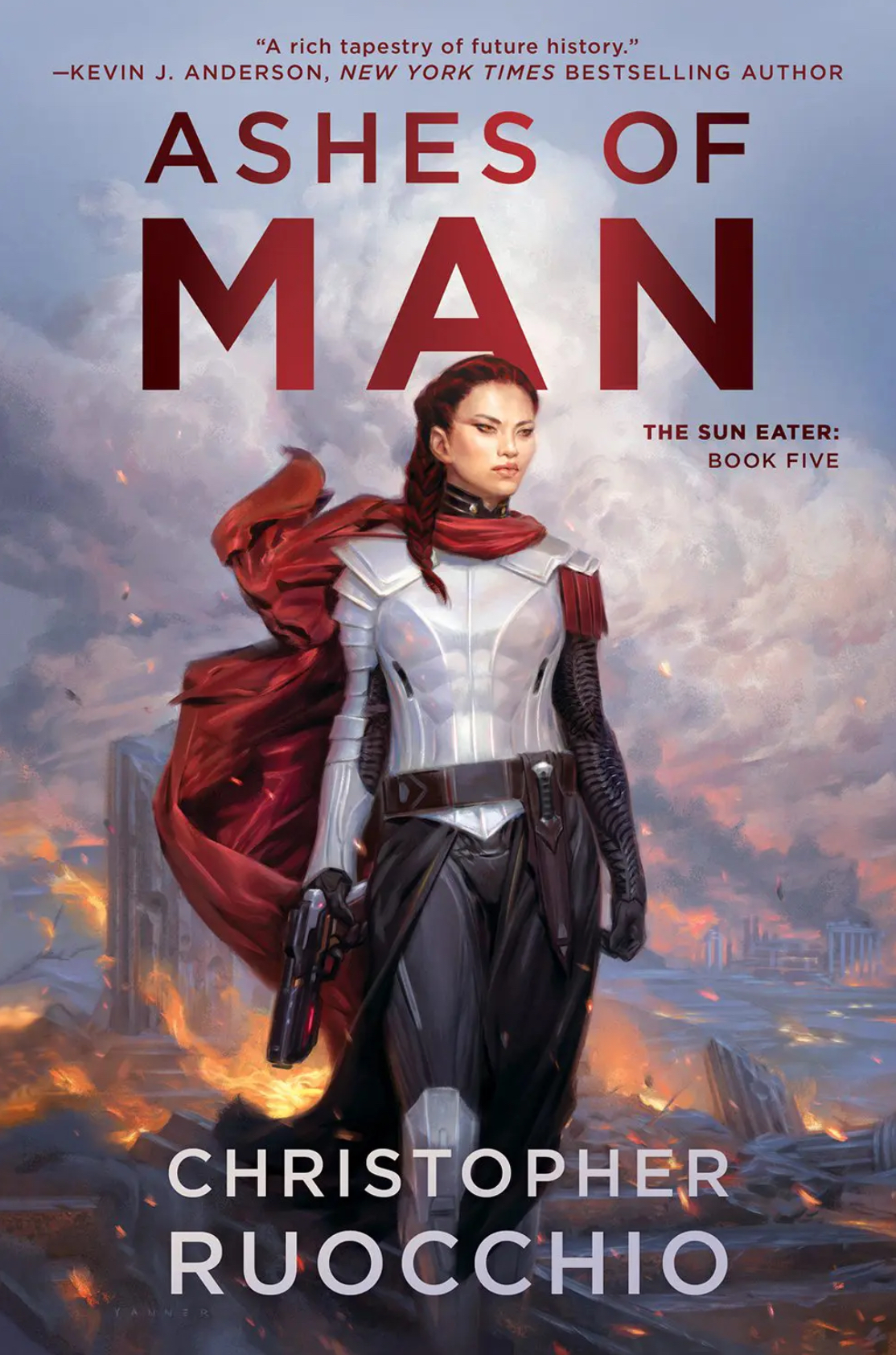
Ashes of Man - Christopher Ruocchio


Ashes of Man
 is the latest in the saga chronicling the life of Hadrian Marlowe, Knight of the Solarian Empire, fast talker and swift actor, the man who wanted to speak to an alien race, and then discovered they were full of monsters, the man who found and fought some of the ancient horrors of Earth's future-past, general, sage, and quite possibly unable to die. Marlowe contains multitudes. The story is written in his voice, giving us his viewpoint and his version of events, and Marlowe is determined that he's not a hero. How he gets from where he is at the start of Ashes of Man to his nebulous, book-writing fate, is rather more unclear. But the clash between who he thinks he is, and the way the galaxy sees him is an interesting one. At the same time, we know that he has a future, at least - and by the same token, we know this is a march toward tragedy and joy in, possibly, equal measure.

 Narratively, this is beautifully crafted. Hadrian is back, rebuilding his life after a term as a POW in the hands of an enemy that is monstrous almost to a fault, creatures who regard humanity as a food source, and are prepared to have a discussion on politics ans the ethics of slavery before hanging you up by your thumbs and devouring your mates. He's not broken, Hadrian, but he's not the same either, someone coming back to terms with himself and with society. He's somewhat untethered, no longer as certain either of his own guiding lights, or of his own self-understanding. It's an interesting look for a man who has led armies, and has now stepped out of the shaodw of death and into a world that seems almost to have forgotten him while he's been away. It's a story that reaches toward reawakening, rediscovery, and change. Not all of that change is good, of course. But if The Howling Darkwas a treatise in part on the fall of man and self actualisation, this is about the rise of that man from his knees, and his determination to be better, and to fight. 

Notably, this feels like a much different book to the one before it, as a more mature Hadrian, scarred in both physical and metaphorical senses by his treatment as a prisoner, resurfaces into the world. There's high politics at play, with factions of the Empire of Man playing off one another and circling for advantage. The Cielcin are still out there too, ravaging worlds and devouring or enslaving the populous. And the Extras, those of humanity who have changed themselves boudy and soul, they're hanging on as well, always looking for means to serve their own inscrutable but typically unpleasant goals. If you're here for politics, good news! And if you're here for thoughts on what makes people who they are, or for examinations of the relationships that keep us grounded, the friendships and loves and sorrows that make us who we are, well, there's a lot of that here too. But this is also a book which packs in a heck of a lot of adrenaline, with the kind of action that can make your heart pound - from orbital bombardment and the graceful quiet dance of death among the stars, to the messy, bloody melee that happens down below, there's something fore everyone. 

And that's what this is, really, a top-notch science fiction adventure story. It's smart, it's occasionally surprisingly funny. It's heartfelt and emotional and genuine. It's bloody and deadly and unafraid. It has action, adventure and really wild things, and it has quiet human moments that remind you who you are and what you have and what you've lost. It also has swords and sorcery and techno-magery and politics and chaos, all in one wonderfully blended package. 

This is, in sum, another winner from Ruocchio; go pick it up.