Sorry friends - everyone in the house has been sick for a week, so going to delay todays post until next week!
Wednesday, September 28, 2022

Tuesday, September 13, 2022
The Mystical Murders of Yin Mara - Marshall Ryan Maresca

Yin-Mara is a city at the edge of the world. At least as far as our protagonists are concerned, anyway. Heading out of the cosmopolitan city of Maradaine, to start a promising academic partnership, the two find themselves walking into a space that is very different to what they're familiar with. From the cusinine to the law enforcement, they do things differently there. Regular Maradaine readers will see a few nods to familiar institutions - particularly law enforcement - but the customs, the language, the presumptions that underpin culture, those are all different here. But what isn't different is the sense of place. A place where you can get sausage and cabbage rolls and a half decent beer. Where most people are just trying to get by, day to day. That some of them are trying to get by with a bit of backstreet magic, or by investigating the gruseome demise of other residents, well, that's by the by.
Except, of course, that it isn't. Because as we come in, our protagonists find themselves torn between the demands of an academic career in magery (including research, arguments with their supervisor, and kowtowing to the nobility who fund everything) and the less lucrative investigation of the aforesaid brutal murders - victims drained dry of life, husks suggesting that it was rather painful too. Something is stalking the streets of Yin-Mara, striking seemingly at random. Whether or not our protagonists will be able to figure out what it is and what it wants before they attract its attention is another matter.. Maresca builds out a cracking thriller from this fairly simple premise. Anyone or anything could be the killer, and as the list of victims starts to ramp up, the question of whether our heroes are stalking it, or it's stalking them becomes rather pressing. The tension ratchets up masterfully, and it certainly left me turning pages rather later at night than I should have been awake, because I wanted to know what happened next.
The emotional heart of the story are Phadre and Jiarna, our protagonists. Young, smart, determined to get somewhere in the world, they've set out into their great adventure with enthusiasm, and with each other. The genuine affection and emotional closeness on the page is visible throughout the story. A pair in love, determined to do not just the necessary thing, but the right thing. Of course this doesrather tend to land them in trouble. But between the magic of one and the razor-sharp mind and iron determionation of the other, there's no obstacle they can't at least attempt to overcome. In their struggles, their failures and successes, their disagreements, make-ups and quiet moments, they steal every page they're on, and I look forward to seeingmore.
That applies to the whole book, really. Yin-Mara is a place crying out for further exploration, and our protagonists are an entertaining, likable duo you can empathise and sympathise with. The story zips along and never outstays its welcome -- but I would happily read more of it, please. If you're looking for a thoughtful, thrilling murder mystery with a dash of magic, this one's for you.
Wednesday, September 7, 2022
Brief outage - back next week!
Apologies for the delay folks - our internet is out.
Back once that's resolved!
Wednesday, August 24, 2022
The Refrigerator Monologues - Catherynne M. Valente

The Refrigerator Monologues is one part superhero deconstruction, one part empowerment of women, one part emotional catastrophe, and all parts acidly funny. I just want to get that out there now. It’s smart, and funny, and unflinching in its exploration of what it means to be, and what it feels like to be a woman, trapped in a world where men are defaulted to being better, and where superheroes are at the apex of casual privilege. Which may sound a bit overwrought - I can only assure you that it isn’t, that it’s a good time, that it offers up a haunting and sharp perspective on the way we treat one half of our society, but that it also builds up people you care about, tells and shows you their stories, and has a good time doing it.
“Fridging” was coined as a way to describe the way the love interests of overwhelmongly male superheroes would typically be murdered in the first act of their stories, the deaths of wives and girlfriends being used to motivate the hero. They weren’t really seen as a person in themselves - instead they were just an object that we pinned “revenge” or “emotional catharsis” to. Nobody wanted to talk about the women themselves, how they ended up in the fridge, and about the fact they were just as interesting and worthwhile as the superheroes they were connected to.
This book sets out to change that; it’s centred on a small club of the relatively recently deceased, who meet and drink coffee in the afterworld, learning each other’s stories, and supporting each other. It’s surprisingly wholesome, though the members range from the dimensionally challenged, through super-scientists to, well, actual villains. But they’re all here now because their lives were seen as part of someone else's story. And credit to the author, she brings the voices of these people back to the fore. Each has a chapter of their own, laying out the story of their life, their death, how they got there. From the Atlantean Princess to the sometime demigod, and back around to the once-photographer, they’re a diverse bunch. And the stories reflect this, as do the voices they use to tell the, That said, there’s a unifying theme in the confidence each story provides, the way it’s paced to allow it to be spoken aloud, and in the sense that these voices are powerful, and have been marginalised by something flashier but ultimately less interesting.
Honestly, it’s hard to talk about the stories in this book without spoiling them. So I’ll just say this: the moments in these pages did, on occasion, actually make me laugh out loud. They did, on occasion, raise an eyebrow or a smile. Sometimes they carried a real emotional punch, something that made me need to put the book down for a few minutes, and think it through. They were real, fierce, angry, thoughtful, funny, deeply true stories. Stories that speak to the way superhero stories treat women, and also about the way we treat superhero stories, and about the kind of stories we want to tell, the kind of heroes we want to talk about. This is a book that gets all that in but also tells genuine, interesting, emotionally human stories, stories that make sense, or at least try to make sense of the world we’re in and the stories we tell ourselves.
Reading this is a good time, and it was a fast, snappy read, but also a thoughtful, and sometimes an emotional one. I’d say if you enjoy comics, or superhero stories, or women pushing back on their marginalisation, or, you know, all three, then this is a great book for you. It certainly was for me.
Wednesday, August 10, 2022
Children of Chicago - Cynthia Pelayo

The book follows Lauren Medina, a young homicide detective, burdened with past trauma. Medina struggles with the mysterious murder of her sister when they were both children, and the gaps in her memory that surround it. She’s built a life around those gaps, and is driven to try and bring justice to other victims, to make the unknown more visible. Medina is closed in on herself, pushing people away because she thinks they’re going to be hurt if they stick too close to her. And there’s always the possibility that she may be right about that. Pelayo draws her protagonist with a fine brush, letting us see the wounds and scars that have closed her up, the marriage on the edge, or past the edge, of failure. The desire to prevent harm, and the obsession it brings that may be past the border of healthy. Medina is a woman on the brink of crisis, following ghosts,snatching victories where she can while fuelled by good coffee and bad food.
The story also explores her relationships, both old and new. There’s the aforementioned marriage, but also a look into the family that shaped her even as it fractured. The way her father, also a police officer, was drawn into a morass of cases, never able to stop working, something Medina mirrors - though her memories of him are typically warm and understanding. THe way her maternal figures were absent or less than approving. It shapes her, this dynamic - and you see that in her interactions. You see it in the way she eyes her partner with suspicion, and in the way that working with her father’s old partner as a mentor lets her relax herself, just a little. Pelayo has wound her protagonist almost as tight as she can go, and the question is perhaps where she’ll put all that energy when she unravels.
There’s other characters of course, other views. I won’t spoil it, but I will say that there’s some portrayals here of both innocents and killers that ring true. Some are delightfully creepy, each turn of the page giving us the mundane, obscurely familiar roots of dissatisfaction that lead to murder. You can read these pages and feel the sad, petty reality of killers - even as the supernatural element spreads through the story like ripples in a pond. There’s something behind the killers, behind the murders, a force of nature, or something else, but it slithers and strides behind a façade of normality. There’s an honesty to the terror, a rawness to it, that feels human in the same way that the grubby details of the crimes, the motives, do too.
Speaking of facades of normality: This is very much a book set in Chicago. If the name didn’t give it away, the lavish descriptions and interjections on the history and folklore of the city certainly will. I thought they were great, honestly, as someone who doesn’t know much about the city; they gave it a depth, a grace and shadow that I wouldn’t have felt otherwise. That said, if you’re not here for a love letter to the Windy City, you might find the digressions less helpful. Personally, I enjoyed them - they made the city feel alive, like another character rather than a stage to be played upon. And the history of Chicago, even that small portion explored here, is a dark one on occasion.
There’s some nice twists and turns here, and the story takes some unexpected pivots as it gets where it’s going, exploring the Pied Piper myth in a more modern setting, exploring a deal where the price is the lives of children, drawn into the depths and never seen again. This is a modern fairy tale, but one explicitly in the mode of Grimm rather than Disney - a fairly tale where rewards are uncertain, and costs can be both high and gruesome.
Is it a good story? In short: hell yes. If you find the nights drawing in a bit, and you want to feel that chill down your spine, then this is the book for you.
Wednesday, July 27, 2022
All The Seas of the World - Guy Gavriel Kay

Regular readers will know I'm a huge fan of Guy Gavriel Kay. His lyrical prose, and careful blending of a slightly alternative historical reality with just a soupcon of the different, the magical, well, it's a joy. Every book manages to make me think about life in a different way, and each book manages to make me feel, deeply, as I fly through its pages. All The Seas of the World is no exception. It's a book with a story that'll keep you turning pages late at night to find out what happens next, but it's also more than that. It's an opportunity to think about the role of small decisions and coincidences, and the way they shape lives. It's an opportunity to think about the ripples our steps cause in the lives of others. And it's an opportunity to explore agency, the way we act on the world. This is a story which, amongst other things, wants to explore the nature of lives and stories, the way the tales we tell ourselves and others are intertwined into a complex web of different expectations and understandings, and common ground between.
Anyway. That's all to say this is a book which manages to balance several plates; not just ponderously ruminating on the human condition, but doing so as flashes of lightning across the sky of a narrative that, well, it does a lot, from assassinations and coups to business ventures and sieges.
In terms of world: this is set in the same world as many of Kay's other alternate-history tales; in this case it feels a lot like some of the early renaissance republics of Italy, with the serial numbers filed off. There's that sense of a mercantile class shifting around the boundaries of aristocracy. The feeling that the centres of power in the world are shifting. The sense that identity is becoming more mutable, perhaps. Or perhaps not. One of the things the book does is dive into the idea of home, and of self, and whether people are the culture they were born into , or the one they were exposed to, or if they shape themselves under or outside of those pressures. It also looks at the costs of breaking with established homes, of walking away from situations as they get out of control, and the costs that come with staying to struggle under the weight of those situations as well. Many of the characters here are trying to decide who they are, in one way or another, and in trying to define and decide that, they shape not only themselves, but a broader conversation.
In any case, the world is a lush, rich, baroque one. Kay's vivid prose fills it with life and energy, and a wry humanity, voices filled with affection, violence, horror, joy, passion, love, and, from time to time, outright stupidity. The world lives and breathes and fights and builds and burns and shines on the page. From the soaring stone buildings of an ersatz Republic, to the sun-drenched cracked flagstones of border forts on the boundary of states in a cold war turning hot, there's an energy and a life that makes the backgrop feel like a living world, one that feels real.
The same applies to the characters, honestly. I don't want to dive inot them in detail, in part to avoid spoilers. But it's always nice to see Kay approach larger issues tangentially, through the eyes of characters who live alongside great events and people we remember from history. This is a story about people who aren't central to the "great individual" theory, but whose choices matter, whose lives matter, whose humanity matters. There's a central duo here, and it's always great to see a well-drawn female protagonist, and some solid minority representation on the page. The pair are smart, and by turns smart, funny, serious and deadly. Really, they're everything that people are, especially people pushed to find their limits and their boundaries in the face of unexpected threats and opportunities.
The story itself is a complex set of interwoven threads, tying characters together half a world apart, or right next to each other. There's murder, mystery, and more than a little mayhem. There's a dash of romance mixed in there, and some lovely platonic interaction by people who give a damn. Chases and battles of wits and unfortunate coincidences and serendipity and blood on the floor and gold in the hand and passion and laughter and tears and, well, life.
This is a damn good story, and if you're an existing fan, it's a damn good Kay story. Go get it.
Wednesday, July 13, 2022
The Assassins of Consequence - Marshall Ryan Maresca
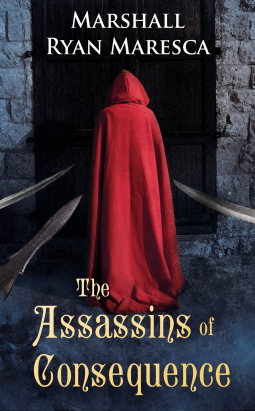
Marshall Ryan Maresca's Maradaine series started with "The Thorn", a university student turned vigilante, with something of a murky past. The series quickly broadened in scope to follow multiple characters in stories of their own, from working beat cops to literal knights in shining armour. But Veranix was the first face of Maradaine. It's fitting, therefore, that in The Assassins of Consequence, his be the first story picked up after the explosive events of the last book, which brought all the various characters together, and lit a fuse. The consequences of the following explosion in the metaphorical fireworks factory are reverberating through the world of Maradaine - and through Veranix.
This Veranix is a mixture of the familiar and the strange. Always a little cocky, he's now trying to risk less, to keep himself and his friends as far out of trouble as he can, while also fighting crime, scowling broodingly from rooftops, and, oh, yes, being a magic student at the university. The university, incidentally, has recently had its magical programme taken over by what passes for a branch of Maradaine's military intelligencee service. Quite why, is another matter entirely. But in terms of chracter, the change dislodges Veranix from his comfort zone. It puts academic pressure on him, it puts demands on him that come backed with social legitimacy. While he's inching closer to his goal of bringing down organised crime boss Fenmere, he's doing so with other pressing calls on his attention. Our superhero is growing up, and not only finding out that heroism has costs, but that both he and others will be forced to bear them, whether they will or not. The text does show us the Veranix we know, in witty banter, athletic leaps from rooftop to rooftop, and daring escapes. But there's a pensiveness, and moments of introspection that suggest the Thorn is more troubled than before, more drawn to being, well, Veranix.
There's some excellent turns by Veranix's gang of do-gooders as well. They're all hanging together, trying to work together to make things better. But they're all pulled by conflicting priorities, loyalties, and their own needs. Sometimes, fighting the good fight in a cape isn't very rewarding, and sometimes you might get appalled at the costs, in life, treasure, and humanity. As a group, Veranix's support team are a joy - each a fully realised individual, with a story
The villains are entertaining, though I must confess that in this case there were rather a lot of them. Fenmere, always the overarching threat, and a host of Veranix's past conquests, getting the band backl together in a jailbreak to go mess him up. And rumblings of others still to come. They're fun to read though, seeing the other side in the vein of Suicide Squad. There's enough moments of humour and humanity to help them not just feel like ciphers, even if the narrative focus is on their grudge, and their scheme to finish it - which, incidentally, includes identifying Veranix, and feeding back into the question of who the man who is The Thorn would be, if he didn't have The Thorn to be any longer.
I won't speak much on Maradaine the city, because I've waxed lyrical on it before. Suffice to say it remains a vibrant, living world. There's ahistory there that you can feel in your bones. And if we don't see as much of it this time around as we have before, we still have the flavour and colour in asides and moments of reflection. Maradaine lives, friends, Maradaine lives. This time it lives in its slums and dockhouses, worn down inns and flashing knives. It lives in its quadrangles and literal walled gardens. In faculty meetings and gang interrogations. It's aplace, still, with depth, and weight.
Anyway. Is it good, then? I don't want to spoil the story, because this one is laced through with turns, twists, chases, escapes, derring-do, moral crises and just plain old crises. I will say that I read it quickly, that I wanted to get to the end and I didn't want it to end. It's maybe not an ideal option for your first Maradaine book (but don't worry, there are lots of entry choices!); but if you're a regular reader, this one is going to follow you around the room. It's great fun, and a great read.
Subscribe to:
Posts (Atom)